Good return during a special year for AP4
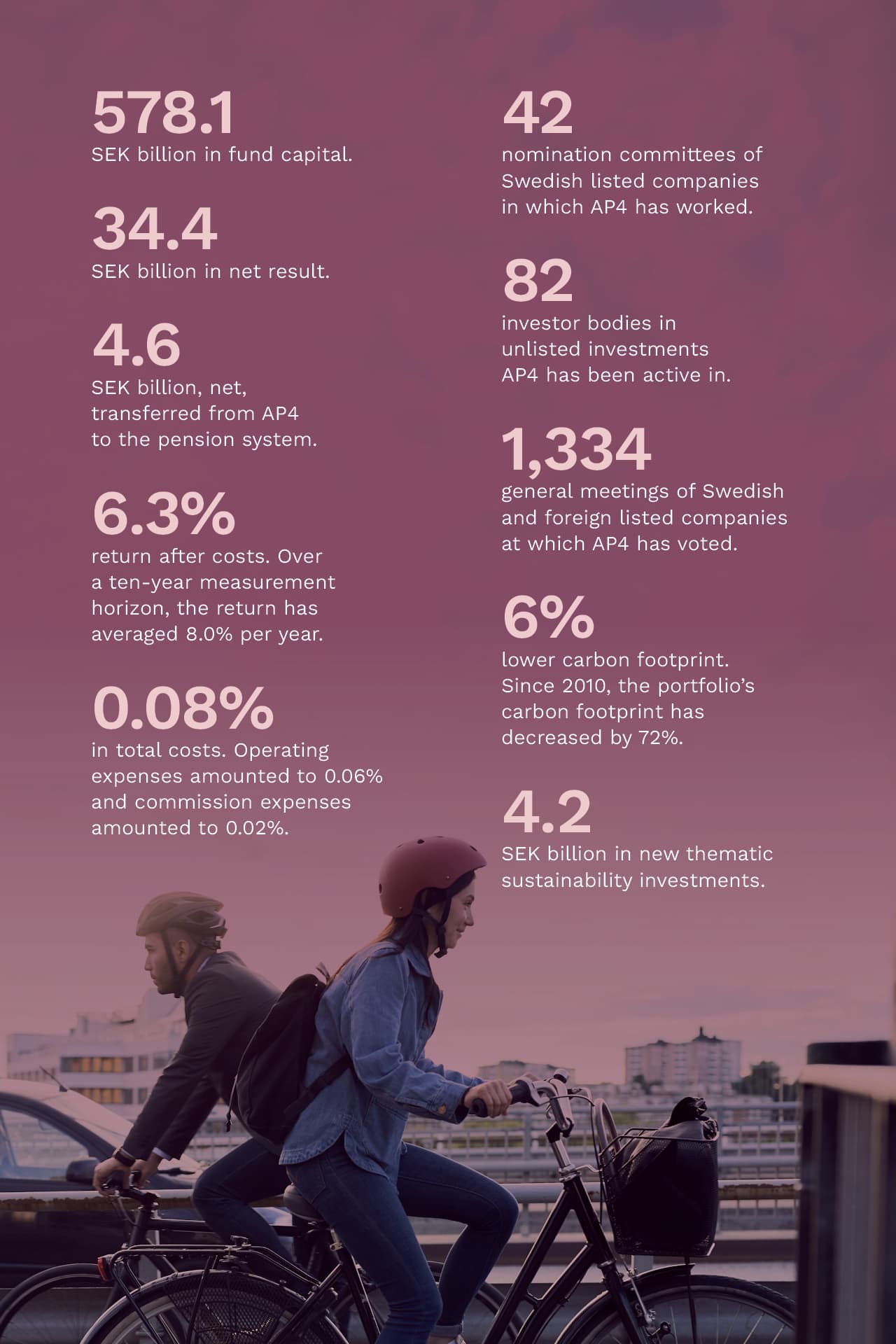
2025 gave a good return for AP4 of 6.3 percent and a result of SEK 34.4 billion. Fund capital increased to SEK 578.1 billion.
Our asset management is long-term with the aim of managing the fund capital to the greatest possible benefit for the income pension system and to contribute to financial security for today's and tomorrow's pensioners.
Asset allocation and management
In order to concretize AP4's long-term mission to deliver high returns, AP4 conducts an analysis of the pension system's needs every three years, a so-called Asset Liability Management Analysis (ALM). The aim is to strive for the balance between expected return and risk that best contributes to the long-term strengthening of the pension system. Based on the analysis, AP4's long-term return targets are determined as well as long-term appropriate intervals for equity shares, currency exposure and the average duration of interest-bearing investments (fixed interest period).
The most recent ALM analysis was conducted in 2023 with the conclusion that the appropriate range for AP4's equity portion was kept unchanged at 50–70 percent of the fund capital. The ranges for currency exposure and the average duration of the fixed income portfolio were also kept unchanged at 20–40 per cent and 3–9 years, respectively.
AP4 invests in most asset classes in order to have the prerequisites to achieve the return target over time. AP4's asset classes are listed equities, divided into Swedish, global and defensive, Swedish and global fixed income, and real assets, as shown in the chart below.
Thematic sustainability investments
AP4 continuously analyses sustainability trends in various sectors and actively seeks investments that are deemed to contribute to and benefit from the transition to a sustainable society. The goal is to make good investments from both a sustainability and a financial perspective.
These investments, which AP4 refers to as thematic investments, are based on an analysis that identifies which value chains are affected and thus expected to be winners and losers in the global sustainability transition. The analysis identifies investment themes that cover approximately 90 percent of global greenhouse gas emissions. These investment themes are distributed across the investments made in 2025, as the chart below shows.